


Choosing A Pet High-Velocity Dryer: The 6 Most Frequently Asked Questions in The Industry
Sep 29, 2026
Leave a message
Anyone in the pet grooming business knows that drying is the most time-consuming part of the process and the stage where things are most likely to go wrong. Consequently, whenever customers ask about high-velocity dryers, the questions tend to be the same few recurring ones. Here, we have compiled and clarified them point by point.
1. What is the difference between a high-velocity dryer, a grooming dryer, and a household hair dryer?
Household hair dryers have low airflow and high temperatures; they rely on heat to gradually dry the fur, which takes a long time and carries a risk of burning the skin. Pet-specific high-velocity dryers take a different approach: they use high-volume airflow to physically blow water droplets away. With strong airflow and lower temperatures, they are far more efficient. In the industry, a distinction is often made between "blowing out water" (removing bulk moisture) and "drying/styling" (finishing the coat). Confusing the two is a common pitfall for beginners.
2. Is a single-motor dryer necessarily worse than a dual-motor one?
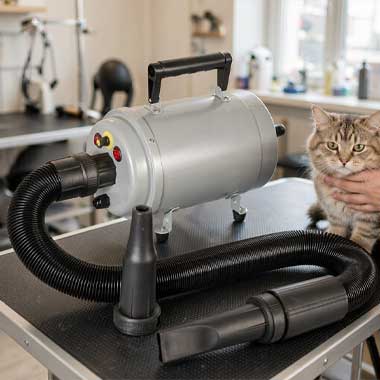
Not necessarily; this is a common misconception. Many people assume that more motors mean stronger airflow, but the drying speed is actually determined by the airflow path design and air pressure, not the number of motors. Some well-engineered single-motor models actually outperform dual-motor models in the same price range regarding wind speed and stability. For example, the "Cat Blow Dryer" from Shanghai Fangzheng Medical uses a single-motor design but achieves a blowing force of 605g and an air speed of 60m/s. In practice, it dries just as fast as dual-motor models, yet the unit is lighter, making it easier for one person to move or mount on a wall.
3. Is the noise level high? Will it scare the pet?
Noise is the primary reason pets resist the drying process. This issue isn't simply a matter of "loud vs. quiet"; it depends on performance at actual operating speeds. In terms of construction, machines with effective vibration dampening and smooth airflow paths produce a sound that is more muffled and consistent, making them easier for cats and dogs to tolerate. From experience, cats are particularly sensitive to high-pitched, harsh noises. Therefore, when choosing a machine for cats, noise levels should take precedence over airflow power; getting the cat to stay still is the prerequisite for achieving a fast drying time.
4. How should temperature and airflow be adjusted to avoid damaging the coat?
The guiding principle is simple: high airflow and low temperature. Use strong airflow to blow away the bulk of the water first; the temperature only needs to be slightly higher than body temperature-just enough to remove residual moisture and smooth out the coat. Many people rush the process by using high heat, which might make the coat dry quickly but actually makes the fur brittle and causes skin redness-issues particularly noticeable in long-haired cats and sensitive dog breeds. Keeping the temperature low rather than high is the industry-standard best practice.
5. How many functions can a single machine handle?
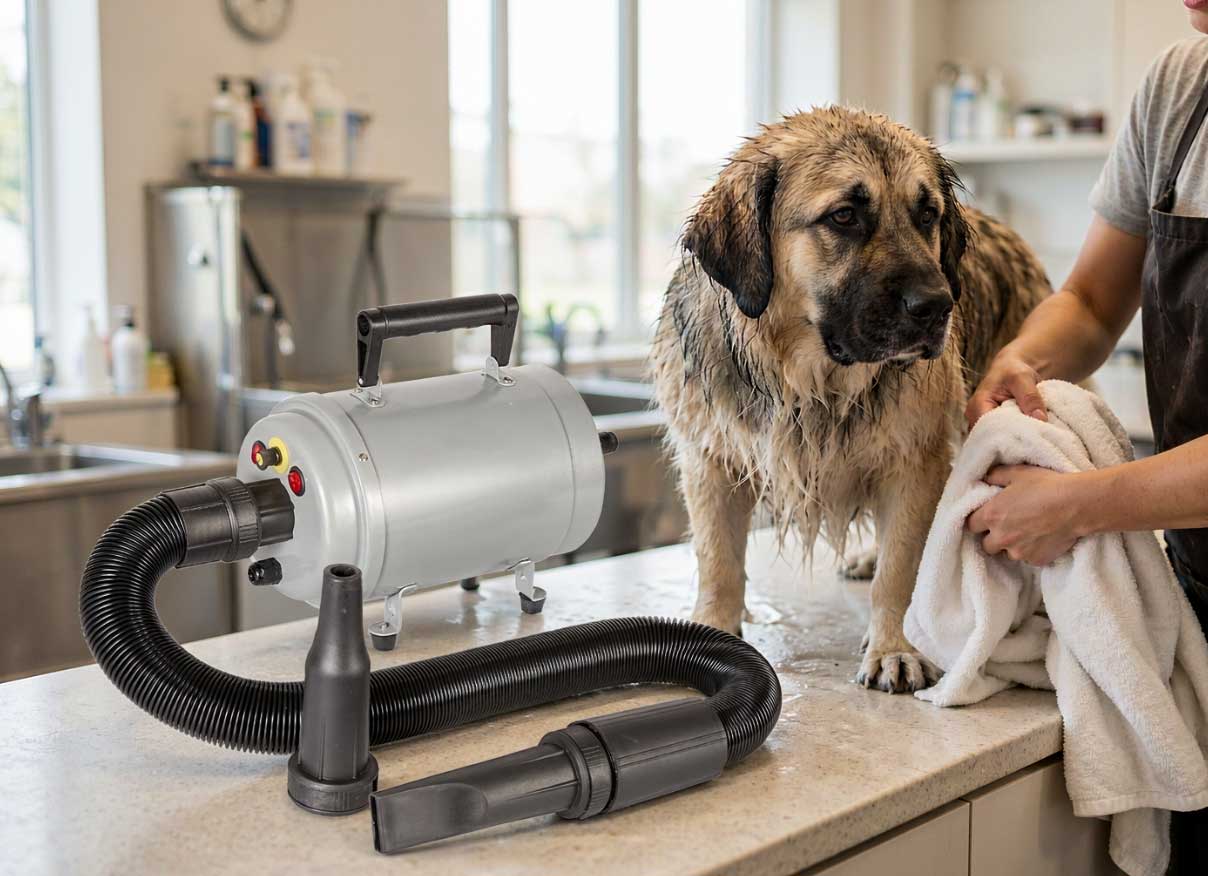
It depends on the design. A high-quality forced-air dryer does more than just "blow water." The model mentioned earlier, for instance, combines powerful water-blowing capabilities with styling airflow and airflow massage functions. It essentially integrates a forced-air dryer, a grooming dryer, and a massager into one unit. This versatility saves the time and effort otherwise spent switching between devices or hunting for power outlets. For grooming shops with high service volumes, this multi-purpose design is far more practical than simply stacking high-end technical specifications.
6. How do I install, position, and maintain it?
These machines generally support two mounting options: wall-mounted (ideal for saving space in cramped shops) or floor-standing (better if the unit needs to be moved frequently). Daily maintenance involves just three tasks: regularly cleaning the air intake filter, ensuring the hose isn't crushed or sharply kinked, and keeping water out of the bearings. Follow these steps, and the machine should run reliably for years. When purchasing, be sure to clarify the warranty period; most in the industry offer 1 to 2 years of coverage.
A final thought
When choosing a forced-air dryer, don't just pick the one with the highest specs; choose the one that best suits your shop's clientele. Prioritize low noise if you serve many cats, and prioritize airflow power and durability if you handle many large dogs. Once you've thought through these six questions and look at specific models-like that Cat Blow Dryer mentioned earlier-you'll likely have a good idea of whether it's a suitable fit for your shop.
Send Inquiry