


Complete Decision-making Regarding Veterinary Surgical lights From Installation Method to Optical Parameters
Aug 19, 2026
Leave a message
The construction of a veterinary hospital operating room involves equipment configuration across multiple professional dimensions. The choice of surgical lights directly affects surgical field visibility, surgical efficiency, and infection control levels. Veterinary hospitals of different sizes and operating models have varying requirements for surgical light installation methods, emergency response capabilities, and space adaptability. Understanding the core parameters of the selection and the applicable scenarios for different installation forms is crucial for making procurement decisions that truly match actual needs.
Core Parameters for Surgical Light Selection
Which Indicators Truly Affect Surgical Outcomes?
Surgical lights have many specifications, but veterinarians need to focus on the following core indicators when selecting a light:
Illuminance
Determines the brightness of the surgical field. An illuminance level of ≥110,000 Lux can penetrate deep tissue incisions, providing sufficient visibility for delicate surgical procedures. Below this value, the visibility of deep surgical fields will significantly decrease.
01
Color Rendering Index (CRI)
Affects the accurate judgment of tissue color. A CRI level of Ra≥95 and R9≥90 ensures that the color difference between arterial and venous blood, and between healthy and diseased tissue, is accurately reproduced. Many aspects of surgery rely on color judgment; insufficient color rendering increases the risk of misjudgment.
02
Color Temperature Adjustability
Adapts to different surgical types. Three color temperature settings from 3800K to 5000K (3800K±300K, 4400K±300K, 5000K±300K) cover different lighting preferences from soft tissue surgery to orthopedic surgery. Some surgical types show better contrast under warmer light, while others show clearer details under cooler light.
03
Spot size adjustment
Electronic adjustment range from 130mm to 160mm to adapt to the lighting needs of different incision sizes and surgical depths.
04
Endoscopic mode (ENDO)
One-button switching to a 9000 Lux low-light mode avoids strong light interfering with image acquisition by the camera system during endoscopic surgery, and eliminates the need for manual dimming to interrupt the surgical procedure.
Heat dissipation design
Affects lamp body temperature and lifespan. A high thermal conductivity aluminum alloy heat sink combined with an increased internal heat dissipation area effectively reduces the core temperature of the LED chip, ensuring low-temperature operation of the lamp body to avoid light decay and equipment failure, while also reducing heat radiation interference to the surgeon.
Laminar flow compatibility
Affects the control of operating room cleanliness. The streamlined lamp body design and precision assembly process optimize airflow, effectively dispersing dust and bacteria, and acting as an invisible air barrier in the laminar flow operating room.
Fixed Installation Options: Ceiling-Mounted vs. Wall-Mounted Installations

For newly built or renovated standardized veterinary hospital operating rooms, fixed installation is the most common choice.
Ceiling-Mounted Surgical Light: Installed on the ceiling of the operating room at a height of 2400 to 2900 mm, the light head is adjustable at multiple angles via a cantilever system. Advantages include not occupying any floor space, not affecting personnel movement or equipment placement around the operating table, and optimal airflow when combined with a laminar flow system. Suitable for comprehensive veterinary hospitals with high surgical volume and established operating room layouts. The wide-body design adapts to various surgical departments, including general surgery, neurosurgery, and orthopedics, and provides continuous and stable operation to meet high-frequency surgical schedules.
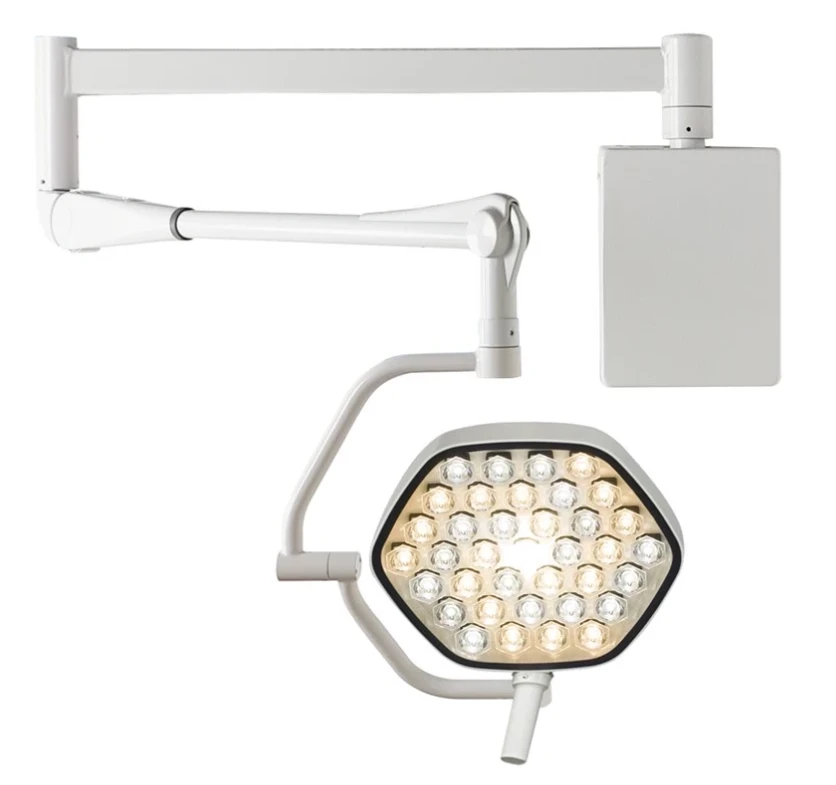
Wall-mounted surgical lights: The Veterinary Wall Mounted Surgical Lamp is installed on the operating room wall and supports an adjustable installation height of 2400 to 2900 mm. Its advantage lies in its lack of ceiling load-bearing requirements, making it suitable for operating rooms with limited ceiling load-bearing capacity or where existing suspended ceiling equipment (such as pendant lights or ventilation ducts) occupies space. Installation location is flexible, allowing selection of the optimal lighting angle based on the operating table layout. Optical parameters are completely identical to ceiling-mounted models, maintaining the same level of functionality including ≥110,000 Lux illuminance, three-stage color temperature adjustment, ENDO mode, and a detachable sterilization handle.
Both types offer identical optical performance; the choice depends on the operating room's spatial conditions and existing installation infrastructure. Choose a ceiling-mounted model if the ceiling load-bearing capacity is sufficient and the space is standardized; choose a wall-mounted model if ceiling conditions are limited or other equipment is already occupying space.
Mobile Solutions: The Special Value of Vertical Mobile Lights and Emergency Mobile Lights

Some veterinary hospitals lack fixed installation options for surgical scenarios, or require sharing lighting equipment across multiple rooms.
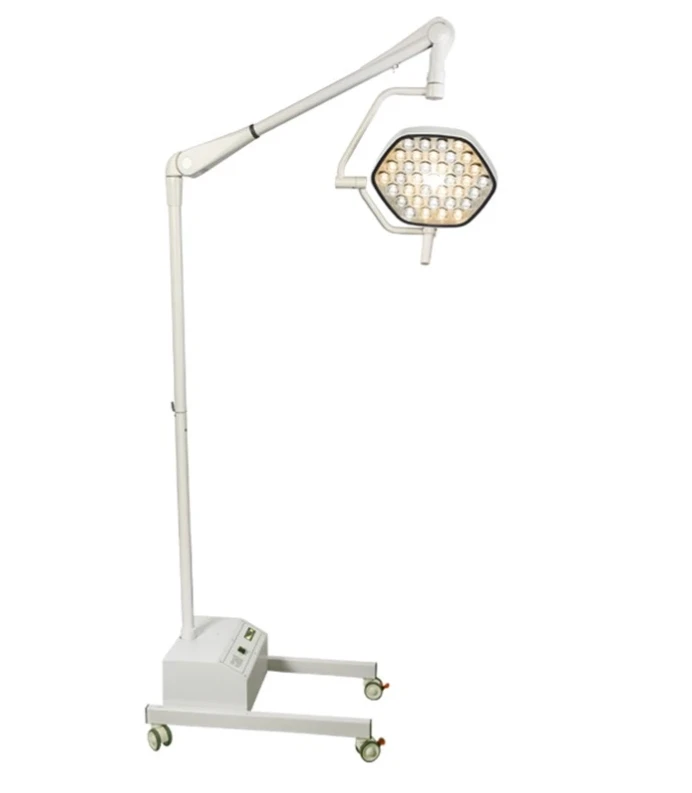
Vertical Mobile Surgical Lights: Mounted on a wheeled mobile stand, these lights can be easily moved to any location. Suitable for temporary surgical areas, mobile clinics, or small to medium-sized veterinary hospitals with a limited number of operating rooms but diverse surgical procedures. They feature a simple design, easy mobility, and maintain the same optical parameters as fixed-installation models.
Mobile Emergency Operating Light: This portable, standing light incorporates an emergency power supply system, with a built-in battery supporting 6 hours of emergency lighting. When mains power is interrupted, the device automatically switches to battery power, maintaining consistent illumination, allowing surgery to continue safely until power is restored or the surgery is completed. It is suitable for areas with unstable power supplies or scenarios requiring extremely high continuity of surgery. An efficient heat dissipation system, combined with the emergency battery module, ensures that the device's temperature remains within a safe range during extended operation.
All models are equipped with a detachable handle, support high-temperature sterilization, and strictly adhere to aseptic operation procedures to prevent cross-infection. The handle allows for flexible control of the lamp head, precisely adjusting the beam position and depth of focus. The remote control supports remote dimming and color temperature adjustment, reducing the frequency of personnel contact with the lamp body during surgery.
The selection logic is quite clear: choose ceiling or wall mount for fixed installation, floor mount for mobile needs, and battery-powered emergency models for unstable power or high emergency requirements. Optical parameters are consistent across the entire series; the differences lie in installation method and emergency capabilities. The best choice is the one that matches the actual scenario.
Send Inquiry