


The Evolution And Intelligent Breakthrough Of Pet Oxygen Chambers
Feb 12, 2026
Leave a message
In modern pet healthcare, oxygen chambers have evolved from a marginalized auxiliary device into a core life support system for intensive care, postoperative recovery, and chronic disease management. Their development profoundly reflects the trajectory of veterinary medicine's shift from general medical care to specialization and precision.
Evolution: From "Oxygen Tank" to "Life Support Platform"
Phase 1: The Period of Simple Modifications (Late 20th to Early 21st Century)
The earliest pet oxygen therapy often directly adopted transparent headgear or oxygen masks used in human medical settings, or was simply modified by veterinarians into simple plexiglass boxes. These devices could only provide a basic oxygen-enriched environment, lacking precise control over temperature and humidity, and even more so, safety monitoring. Essentially, they were just "oxygen boxes," with significant limitations such as high leakage rates, high stress levels for pets, and inconvenience for medical personnel.
Phase 2: Specialization and Basic Integration (First Decade of the 21st Century)
As the pet healthcare market expanded, the first dedicated pet oxygen chambers emerged. These devices began using more robust materials (such as acrylic or early stainless steel) and integrated basic flow meters and observation windows. Their designs started to consider pet size, with models for cats, small dogs, and other specific needs. However, at this stage, the equipment still heavily relied on manual monitoring, had inaccurate temperature control, weak safety systems, and low levels of automation.
Phase 3: Systematization and Security Upgrades (2010s to present)
Over the past decade, pet oxygen concentrators have entered a period of rapid development, with core demands shifting towards "safety, stability, and controllability." The equipment generally uses medical-grade stainless steel and integrates digital oxygen concentration monitoring, basic temperature control, and alarm functions. Design considerations now focus on reducing pet stress, such as increasing sound insulation and improving visibility. It has evolved from an oxygen supply device into a rudimentary life support environmental control system.
Comprehensive Protection of Intelligent Security System
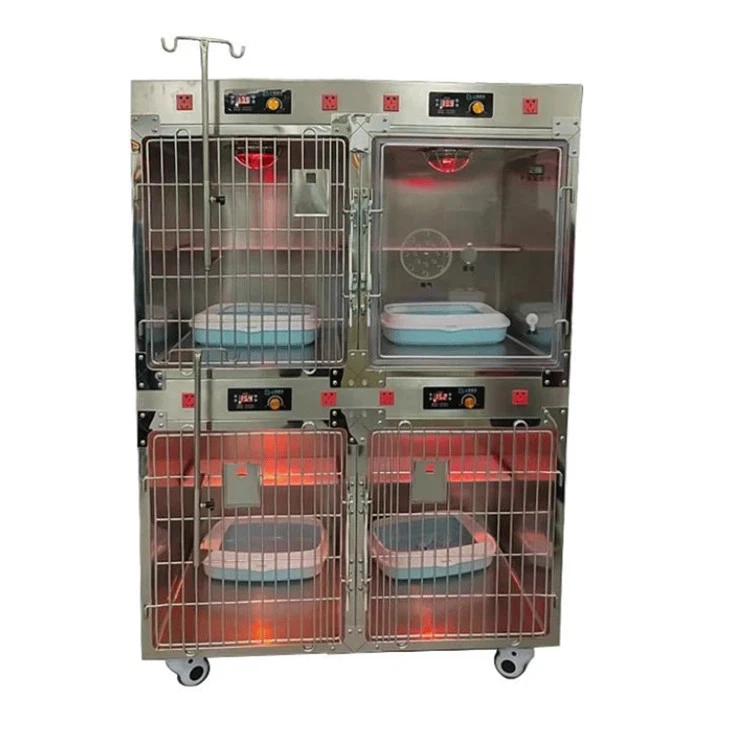
Building upon this evolution, cutting-edge pet oxygenation chambers have achieved a significant breakthrough by integrating materials science, intelligent control, and veterinary medicine. For example, a cat and dog oxygen chamber, representing the highest industry standards, is redefining the boundaries of safety and professionalism.
Robust and Safe
The cat and dog oxygen chamber is made entirely of 304 stainless steel, offering excellent corrosion and rust resistance, easy sterilization, and a robust structure capable of withstanding the pressures of treatment. The unique sliding door features an automatic locking system that operates smoothly and effectively prevents pets from pushing it open from the inside or from accidentally opening it from the outside, creating the first line of physical security.
The equipment integrates three core systems, forming its "intelligent brain":
Pet- and Healthcare-Centered Design
- Stress Reduction:A stable environment and low-noise operation help reduce anxiety in sick pets.
- Efficiency Improvement:Automatic door locking and clear status indicators make operation more convenient for healthcare personnel, allowing them to focus more on monitoring the pet's condition.
- Efficiency Enhancement: Expanded applications: Its stable, safe, and controllable characteristics not only meet the needs of critical care oxygen therapy, but also make it suitable for long-term care in high-end foster homes or families with chronic diseases (such as cardiopulmonary insufficiency) that require special environmental management.

From a rough, transparent box to today's comprehensive life support platform integrating medical-grade stainless steel, intelligent temperature control, multiple active safety features, and human-centered design, the evolution of pet oxygen chambers is a history of pet medical equipment following the essence of medicine and continuously pursuing higher safety and precision. Today, devices like the aforementioned intelligent oxygen chambers are no longer merely tools for delivering oxygen, but rather construct a "life ark" for the stable recovery of fragile lives. This marks a new stage in pet critical care care, characterized by controllable environment, quantifiable safety, and intelligent operation, providing a more solid hope for life for our furry friends.
Send Inquiry